Quit Eulogizing the Black Church

In February 2010, Princeton scholar Eddie S. Glaude Jr. published a provocative essay in the Huffington Post titled “The Black Church is Dead.” The piece ignited a firestorm. Some praised it as a long-overdue hard truth, while others condemned it as elitist and out of touch. Nearly everyone on both sides, however, made the same mistake: they read it as a death certificate for Black church engagement with social struggle.
That is not what Glaude actually argued, however. His thesis was more precise and, I would contend, more useful. What had died, he wrote, was not Black churches themselves, but the idea of the Black church as a singular idea. What remained were Black churches in the plural, in all their diversity, contradiction, and vitality.
He was right about that. Unfortunately, the misreading of his eulogy has done real damage by feeding a narrative that was already well entrenched. That narrative goes something like this: once, not so long ago, the Black church was the moral backbone of a movement. It marched. It organized. It sheltered freedom riders and launched voter registration campaigns. It produced prophets. And then, somewhere around April 4, 1968, after the assassination of Dr. Martin Luther King Jr., it got prophetic laryngitis and retreated into respectability, prosperity, and political quietism. The Black church, this narrative insists, abandoned its calling as an agent of social transformation and has never fully returned.
I am writing not to romanticize the Black church and not to excuse its failures, but to interrogate this revisionist narrative and insist on the historical record, which is considerably more complicated and considerably more hopeful than the eulogy suggests.
The Problem of the Monolith
Before we can honestly assess what the Black church has or has not done, we must reckon with a foundational problem of definition. “The Black church” is not a naturally occurring institution. It is a social scientific construct, a term forged by scholars studying African American religious life as an institutional specimen rather than as the extraordinarily complex constellation of congregations, denominations, doctrines, cultures, and regional traditions it actually represents.
This is not a new observation. W.E.B. Du Bois, writing in The Souls of Black Folk and later in The Negro Church, for instance, grappled with the diversity and internal tension within Black religious life even as he attempted to describe its common features. Carter G. Woodson, in The Miseducation of the Negro, pressed further still. He lamented the ways Black intellectuals educated in white or more liberal institutions had distanced themselves from Black churches rather than investing in their development. Woodson’s critique was not that the Black church had failed the community. It was that the community, especially its educated class, had in many ways failed the church.
More recently, Raphael Warnock, in his essential work The Divided Mind of the Black Church, maps the deep and persistent internal tension within Black religious life between the tradition of prophetic protest and the tradition of personal piety. Warnock’s deeper question is whether these streams must remain in conflict or whether piety and protest might be held together as a unified, Spirit-empowered witness. His framing matters precisely because it resists the urge to flatten the Black church into a single story. There have always been multiple Black churches, with multiple theologies, multiple politics, and multiple understandings of what faithful witness requires.
When we ignore this complexity and treat the Black church as a monolith that either heroically marched or shamefully retreated, we commit an act of intellectual dishonesty that sets us up for the very myth we most need to dismantle.
The Golden Age That Never Was
Here is the hard truth at the center of this conversation: the civil rights era Black church was never as uniformly engaged as our collective memory insists. Research suggests that only approximately 3 percent of Black congregations were institutionally active in the civil rights movement. That does not mean there were no activists in Black church pulpits or pews; there were, in enormous numbers. As institutions committing their buildings, their budgets, and their corporate witness to the movement, however, only a small minority were fully enrolled.
The evidence is not abstract. Consider the National Baptist Convention, the largest Black Protestant denomination in the country. Its president for decades, Joseph H. Jackson, did not support Dr. King’s nonviolent direct action campaigns. His approach was more conservative or nationalist and more focused on institution-building than on confrontation. The conflict between his vision and King’s grew so acute that King’s allies eventually broke away to found the Progressive National Baptist Convention in 1961, a denomination born in direct protest of the dominant model of Black Baptist social engagement.
Or consider Chicago, where Pastor Clay Evans invited King to speak and organize at his congregation and was subsequently blackballed by other Black pastors for doing so. The movement was never monolithic, and neither was the church’s response to it.
We have constructed a golden age that, upon closer inspection, was always a far more complicated picture. The period from Reconstruction through the civil rights era certainly produced extraordinary prophetic witnesses. It also produced accommodation, division, and active resistance to the very movements we now celebrate. To pretend otherwise is not to honor our legacy. It is to distort it and to use that distortion as a blunt instrument against the churches of today.
A Spectrum, Not a Standard
Robert M. Franklin, in his landmark work Crisis in the Village: Restoring Hope in African American Communities, offers a framework that cuts through the mythology with precision. He describes Black churches as existing along a spectrum of five phases of ministry: charitable relief, midterm support, social services, justice advocacy, and comprehensive community development. The crucial insight is that no congregation and no denomination operates across all five phases at all times. Some churches focus primarily on charitable work, meeting immediate needs with food, clothing, and emergency assistance. Others invest in social services including counseling, youth development, and housing support. Still others organize economic action, pursue legislative change, or develop land and housing through community development corporations. Many engage several of these at once, in different proportions, across different seasons.
This spectrum is not a hierarchy. A congregation faithfully running a food pantry and a GED program is not failing to be prophetic. It is doing the priestly and servant work its community requires, with the resources it has, in the tradition it has received. The question has never been whether every Black church does everything. It has been whether the full range of ministry across the full spectrum is present and active. It is. It has been. As it relates to justice work specifically, by almost any honest measure, the scope of that engagement is broader today than it was sixty years ago.
More Churches, More Engaged
Here is the argument that almost never gets made: there are probably more Black churches actively engaged in civic and justice work today than there were during the era we romanticize. Consider the mathematics. If only approximately three percent of Black congregations were institutionally active in the 1950s and 60s, and if the overwhelming consensus among Black pastors and denominational leaders today is alignment with the Kingian tradition rather than the Jacksonian one, then the landscape of engagement has genuinely shifted.
More pastors preach justice from the pulpit. More congregations participate in civic coalitions. More denominational bodies have adopted justice platforms as official positions. The National Baptist Convention under President Boise Kimber, for example, has reasserted its commitment to social justice advocacy. The Progressive National Baptist Convention has never wavered from its founding prophetic mandate. Across the COGIC, AME, AME Zion, CME, the Full Gospel Baptist Church Fellowship International, Black Apostolic denominations, and Disciples of Christ communities, among others, you will find bishops, pastors, and congregations who are not apostates from a justice vision but its active inheritors. They show up at city halls, courthouses, and state legislatures. They organize clergy cohorts around criminal justice, health equity, voting rights, housing, and economic justice. They are not waiting to be discovered. They are already there.
The Work Is Being Done
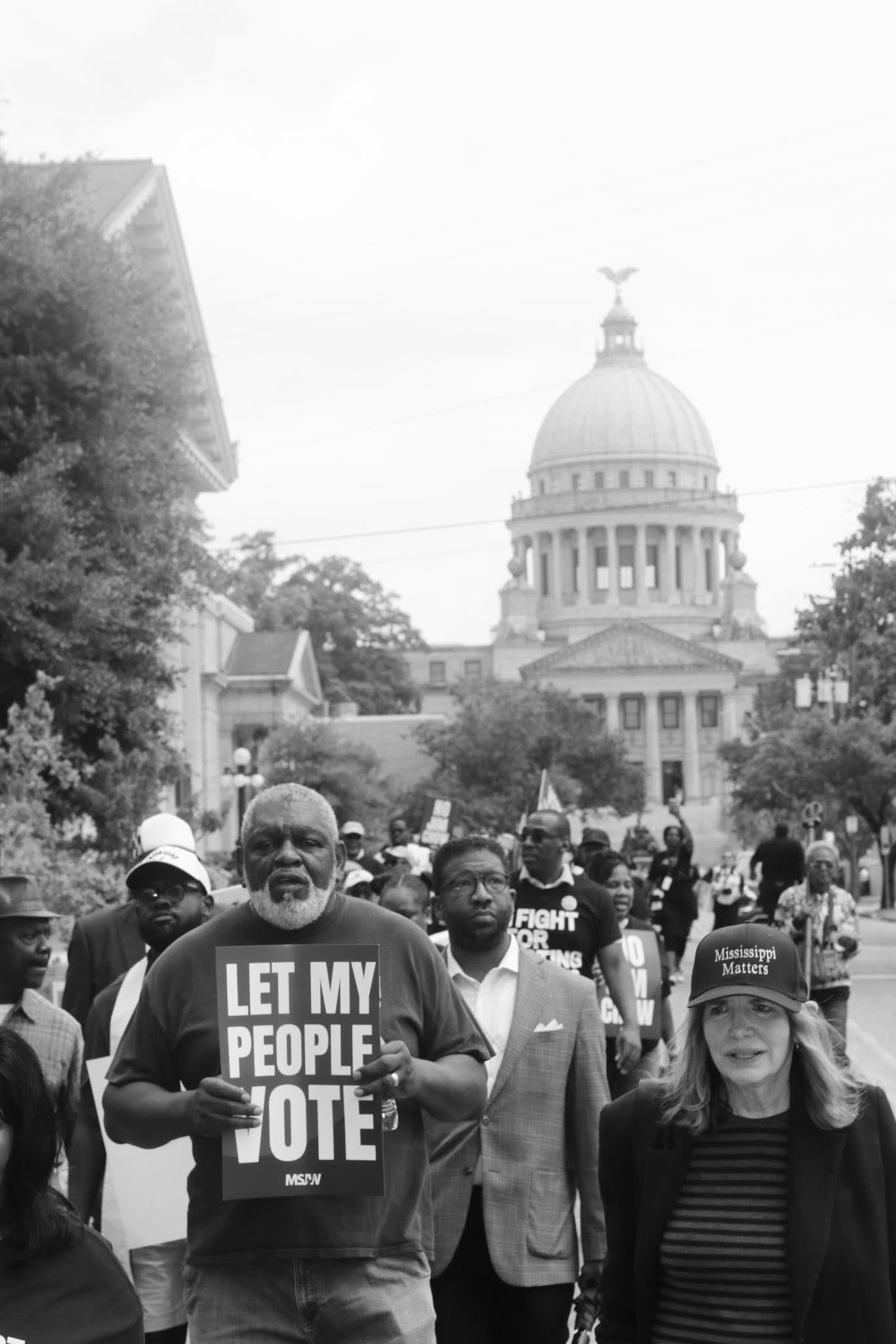
I can speak to this from the ground, not from a distance. In Mississippi, one of the most structurally unequal states in the nation, Black clergy and congregations are active on multiple fronts simultaneously. Through Clergy for Prison Reform, which I founded, Black pastors across the state have organized around the dignity and humanity of incarcerated people and their families. Clergy joined the successful campaign to change the state flag, which bore the Confederate battle emblem for over a century. We have pushed for Medicaid expansion and advocated for the restoration of voting rights for returning citizens. As 3rd Vice President of the General Missionary Baptist State Convention of Mississippi, I can tell you every year we are engaging in those five phases of ministry.
Mississippi is not exceptional. It is representative. Black churches throughout the nation are doing work collaboratively with the NAACP, Rainbow PUSH Coalition, National Urban League, National Action Network, the Poor People’s Campaign, the Black Church PAC, Faith Out Loud, Conference of National Black Churches, among others. When people ask where the Black church is, I want to ask them back: where are you looking? The work is not hard to find. It is only hard to see if you have already decided it is not there.
An Altar Call
Dr. King himself said it plainly: it has never been everybody. It has always been a dedicated, creative minority that moves history forward. The civil rights movement was not carried by all Black churches. It was carried by a committed few, supported by many, and opposed by some. That is the record, and that has always been the record. By that same standard, the work being done today by faithful Black congregations across this country is not a disappointment. It is a continuation.
The answer to “where is the Black church?” is not a eulogy. It is a geography lesson. The Black church is on the corner, in the statehouse, at the jail, in the classroom, at the ballot box, and in the streets. It is imperfect, diverse, sometimes frustrating, and absolutely irreplaceable. What we do not need is another obituary written by someone who has not attended a church board meeting, a denominational convention, a clergy organizing session, or a legislative hearing where Black pastors showed up again to speak truth to power.
What we do need is more amplification of those doing the work, more resources flowing toward those in the fight, and more scholars, writers, and public intellectuals willing to stop critiquing from a distance and start investing in the communities they claim to care about. As Woodson urged, write and teach among the people rather than simply lamenting them.
And if you are already in the work, if you are the pastor organizing your clergy cohort, the deacon chairing the housing committee, the layperson running the prison ministry, know this: the narrative of the fallen Black church is not about you. Do not let it demoralize you. Keep going.
Say your prayers. Roll up your sleeves. Connect with the congregation, the coalition, the denomination doing the work in your community. And let us get it done.
The Black church never left the fight. Quit writing its obituary.
"Write and teach rather than lament". I got my assignment. Bless you
Thank you for highlighting the multifaceted relevance of the Black Church.